Discipline 03
RF
RF front ends, characterisation and system integration. In this discipline the fixture is part of the measurement — a good front end measured badly tells you nothing useful, and a marginal one measured well tells you exactly where the problem is.
- Scope
- Front-end design, matching, filtering, shielding, fixture design, characterisation and integration
- Characterised by
- Shielded, repeatable measurement with the fixture and calibration recorded alongside results
What this covers
Design the fixture, then trust the number
An RF measurement is only as good as the path between the instrument and the device. Cable loss, connector repeatability, fixture resonance and shield integrity all contribute to the result, and all of them can be larger than the effect being investigated. Getting a fixture right is therefore not preparation for the engineering — it is part of it.
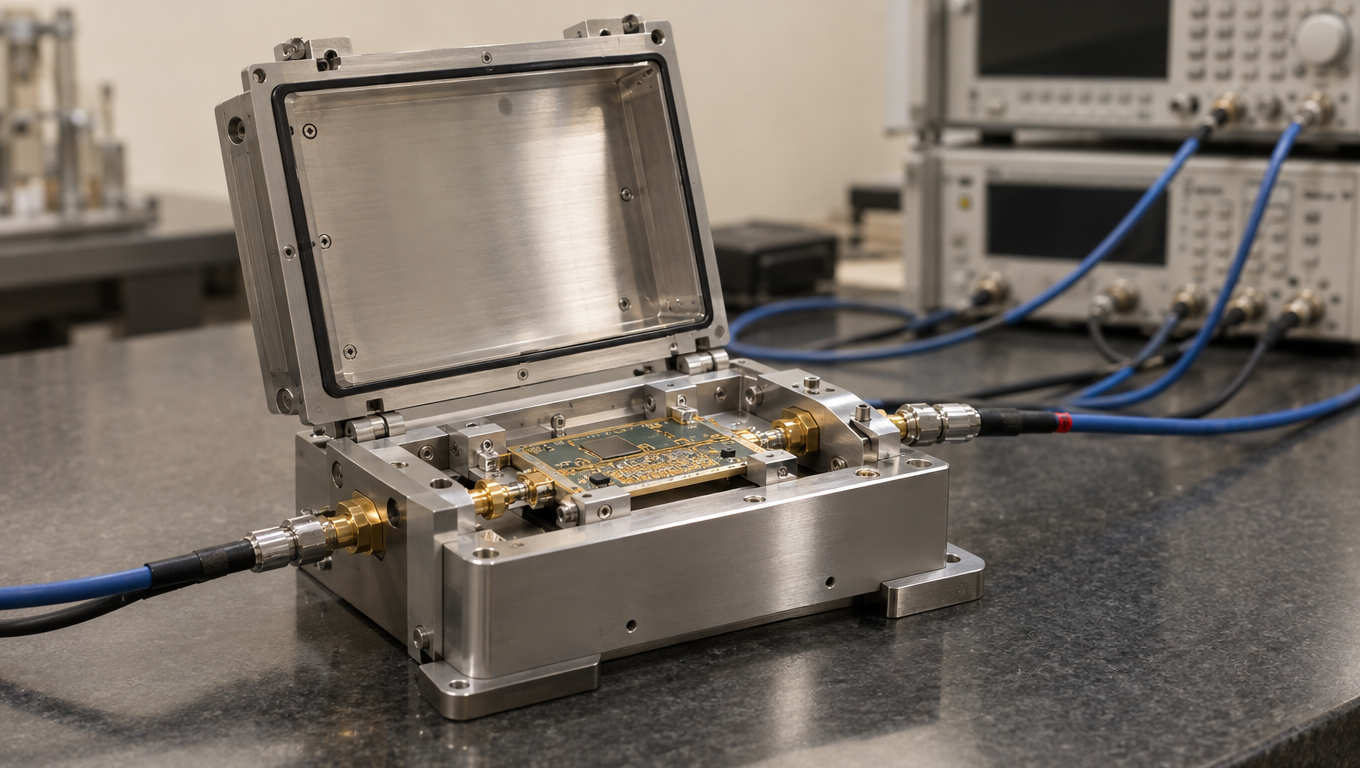
SION designs shielded fixtures with the device's actual geometry in mind: a machined cavity that suppresses radiation, gasketed seams, controlled launch geometry and a lid that closes to the same position every time. The fixture is characterised on its own first, so that when a device measures unexpectedly there is a reference to compare against.
Integration is the second half of the problem. A front end that passes on the bench can change behaviour once it sits beside a switching supply, a digital bus or an antenna that couples back into it. The system-level measurement is what settles the question, and it is planned from the start rather than added after a field issue.
01Front-end design
Amplifier and filter topology, matching networks, gain distribution and linearity budgeting, designed against the signal levels the system will actually present.
02Shielding and grounding
Cavity design, seam and gasket strategy, feedthrough placement and grounding discipline that keeps the enclosure from behaving as part of the circuit.
03Fixture engineering
Machined fixtures with repeatable clamping and controlled launches, characterised independently and documented so a measurement can be repeated later.
04Characterisation
Gain, return loss, isolation, compression and noise behaviour measured across the band and the temperature range, with calibration state recorded.
05Coexistence
How the front end behaves next to the digital and power circuitry it will live with — usually the difference between a bench result and a product result.
06System integration
Integrating the RF chain with the antenna, the enclosure and the processing side, and verifying the assembly as installed rather than as designed.
Typical failure modes
Why RF results do not reproduce
Fixture repeatability
A lid that closes differently each time changes the measurement. Addressed by clamping design and by checking repeatability before trusting a result.
Connector and cable drift
Torque, mating cycles and cable movement all shift the reference plane. Addressed by calibration discipline and by recording the setup with the data.
Enclosure coupling
A shielded box that resonates at a frequency of interest, or a seam that radiates. Found by characterising the fixture empty before the device goes in.
Power supply interaction
Front-end behaviour that changes with the regulator's switching phase. Found by measuring with the real supply rather than a laboratory source.
Where this connects
Related disciplines, products and capabilities
Program inquiry
Bring us your requirements.
If your RF measurement does not reproduce, or a front end behaves differently in the product than on the bench, start with the fixture and the supply.