Capability 03
Software & Integration
Hardware that cannot be interrogated cannot be tested, and hardware that cannot be tested cannot be qualified. SION writes the firmware, drivers and diagnostics that turn a board into an instrument, then integrates the application software around it.
- Scope
- Firmware, drivers, board support packages, diagnostics, application software, hardware–software integration
- Typical entry point
- New hardware needing its first software layer, or an existing product needing its diagnostics hardened before formal test
What this covers
Diagnostics are the deliverable that outlives the program
On a long-life system, the software that matters most is not the application — it is the layer that lets a technician at a remote site determine what has failed and why. That layer has to be designed at the same time as the hardware, because it depends on which signals are observable, which registers are readable and which faults can be distinguished from each other.
SION builds firmware in layers: a hardware abstraction that isolates board specifics, a driver layer per interface, a diagnostic layer that exposes state in a way a test procedure can assert on, and the application on top. That separation is what makes it possible to move the design to a new board revision, or to a different processor, without rewriting behaviour.
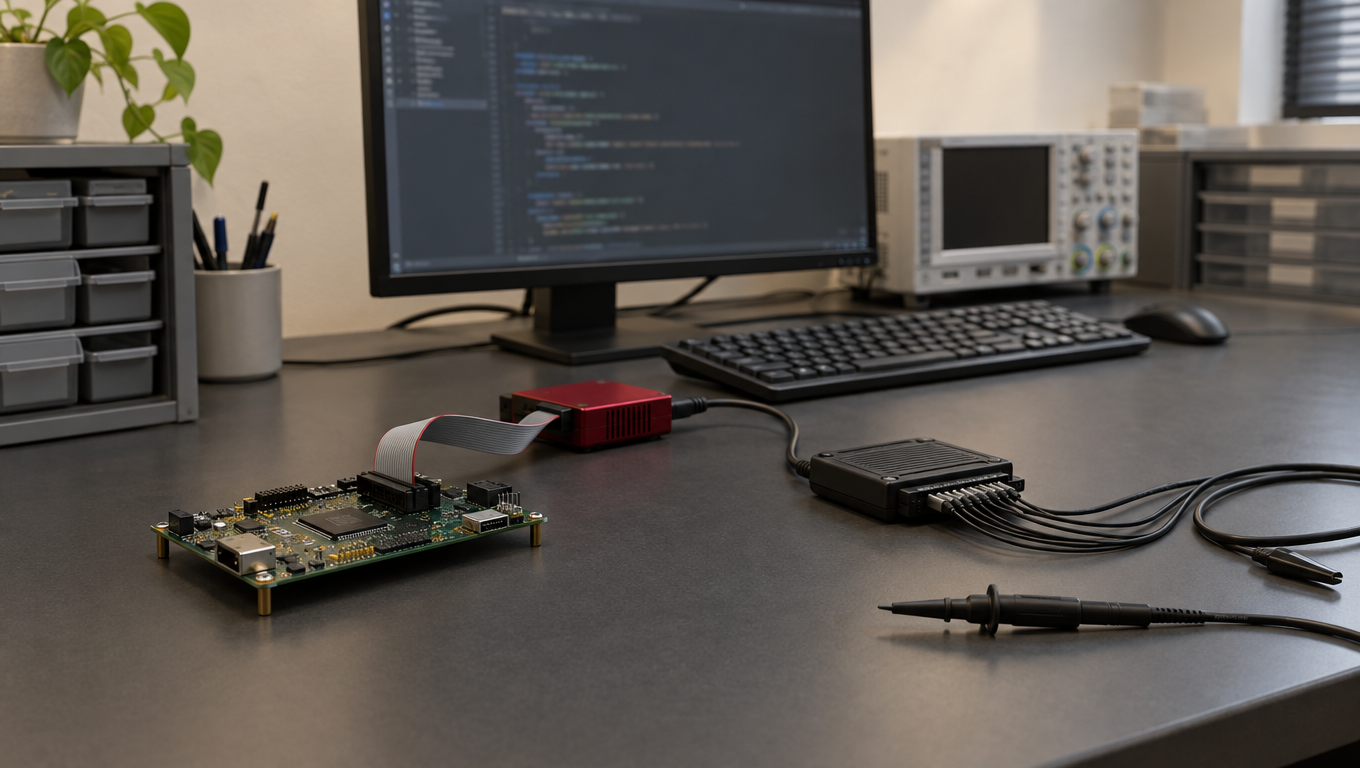
Integration is where the assumptions from silicon, board and firmware meet. It is normal for those assumptions to disagree. The work is to find the disagreement early on a bench, with instrumentation, rather than in a qualification chamber where the diagnosis is expensive.
01Firmware and boot
Boot sequencing, secure or verified boot where required, clock and power initialisation, and a recovery path that does not depend on the application being healthy.
02Drivers and board support
Interface drivers for the buses the design actually uses, written against the device documentation, with the errata that apply noted and handled.
03Diagnostics and built-in test
Power-on self-test, continuous health monitoring, fault codes that map to a maintenance action, and logging designed for a site technician rather than a developer.
04Application software
Control loops, protocol handling, data path management and host interfaces — scoped to what the program needs, with the architectural boundaries documented.
05Hardware–software integration
Bench integration in dependency order, protocol conformance checks against the peer device, timing verification with instrumentation, and a written record of every interface proven.
06Test tooling and automation
Scripted test sequences and bench automation that let the same checks be re-run after a change, so regression evidence exists without a manual effort each time.
Program mechanics
Customer inputs, engineering deliverables and acceptance criteria
Software scope is agreed against a written interface and behaviour specification. Where an existing codebase is involved, an initial review precedes any estimate.
Customer inputs
- Target processor or FPGA and the toolchain already in use, if any
- Interface specifications and the peer devices each interface must talk to
- Functional behaviour required of the application, at the level of observable outcomes
- Existing code, coding standards and configuration management conventions
- Diagnostic and maintenance expectations — who services the unit and with what equipment
- Any certification or process standard the software must be developed under
Engineering deliverables
- Software architecture
- Layer boundaries, interface contracts, boot and recovery strategy.
- Source and build system
- Reproducible builds from the delivered scripts, under configuration control.
- Driver documentation
- Each interface implemented, the device assumptions behind it and the errata handled.
- Diagnostic specification
- Self-test coverage, fault codes and the maintenance action each maps to.
- Integration test record
- Interfaces proven, with the method and instrument used for each.
- Automation scripts
- Repeatable bench test sequences for regression after change.
Typical acceptance criteria
- All specified interfaces demonstrated against the real peer device, not a simulator
- Boot completes from cold power with no manual intervention, including after an interrupted update
- Diagnostic self-test detects an injected fault of each class the specification names
- Builds reproduce from a clean checkout using only the delivered instructions
- No unresolved issue at the severity level agreed in the program plan
- Regression scripts pass on the delivered hardware revision before handover
On figures. Latency, throughput and boot-time figures are measured per program on the target hardware and provided with the measurement conditions. SION does not publish performance claims for customer software without that evidence.
Where this connects
Related capabilities, disciplines and industries
Adjacent capabilities
All capabilitiesProgram inquiry
Bring us your requirements.
If your hardware needs its first firmware layer, or your diagnostics are not yet strong enough to support a formal test campaign, tell us where the gaps are.