Capability 04
Verification & Qualification
Functional verification, production QA, reliability and environmental testing support — plus the planning that makes a formal qualification campaign possible. Test standards and facility arrangements are confirmed per program, not assumed.
- Scope
- Functional verification, production QA, reliability, EMC/EMI, environmental testing support, qualification planning
- Distinct activities
- Radiation-hardening design and radiation test support are separate work packages, not defaults
What this covers
Test readiness is a design property, not a late-stage activity
A qualification campaign can only prove what the hardware lets it observe. If a board has no test points on its critical rails, no way to inject a fault, and no diagnostic output that distinguishes one failure from another, the campaign becomes a series of experiments rather than a set of measurements. That is a design decision, made early.
SION plans verification against the requirements from the start: what will be measured, with what instrument, at what condition, and what result counts as a pass. The plan is written before the hardware exists so that the hardware can be built to support it. Bench verification catches the ordinary errors; the qualification campaign is then reserved for the environmental and reliability questions that only a chamber or a test house can answer.
EMC and EMI work follows the same logic. Pre-compliance measurement on the bench, with an idea of which cable and which aperture is likely to be the problem, is far cheaper than discovering it at an accredited facility with a schedule attached.
01Functional verification
Requirements-to-test traceability, bench procedures, interface conformance against the real peer device, and a written record of every check with its result and conditions.
02Production QA
Manufacturing test strategy, test coverage against likely failure modes, fixture and programme definition, and first-article inspection procedures that production can repeat.
03Reliability
Derating review, thermal margin assessment, accelerated life test planning, and failure analysis support when a sample does not behave as predicted.
04EMC/EMI support
Pre-compliance measurement, emissions and immunity problem isolation, grounding and shielding review, and preparation of the hardware and documentation for accredited testing.
05Environmental testing support
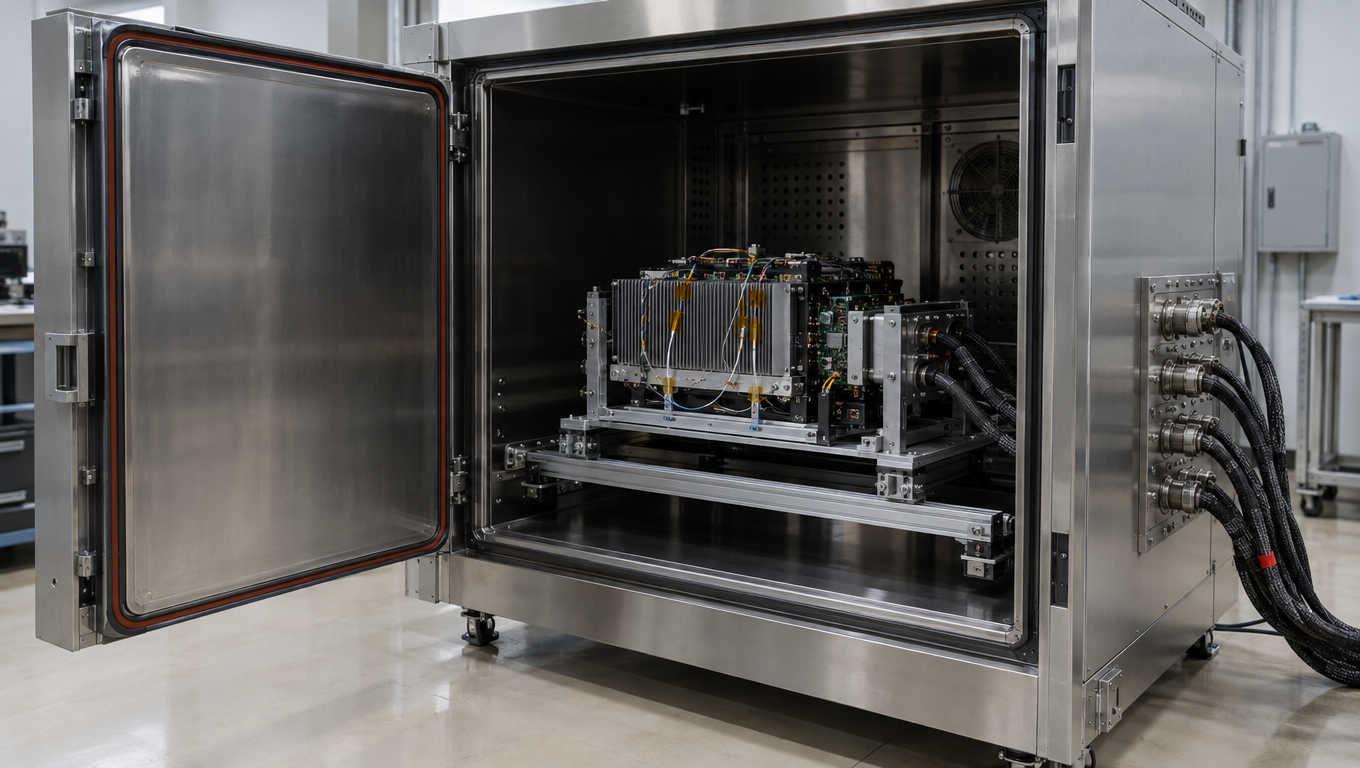
Test plan definition, chamber instrumentation, in-test monitoring, and interpretation of results — arranged against the conditions the program specifies.
06Qualification planning
Sequencing, sample allocation, acceptance criteria and evidence packaging, aligned to the customer's standard or the program's contractual obligations.
Two activities kept separate
Radiation-hardening design is not radiation test support
These are frequently conflated in program discussions, and conflating them leads to budgets that do not match the work. They are distinct activities with different skills, different facilities and different deliverables.
Radiation-hardening design is a design activity. It covers the choices made in architecture and layout that reduce sensitivity — device and process selection, error detection and correction, voting and redundancy structures, watchdog and recovery behaviour, and layout techniques that limit single-event effects. It produces a design that is intended to behave predictably in a radiation environment, and it is documented as part of the design record.
Radiation test support is an assurance activity. It covers the planning and execution of testing at an appropriate facility, the instrumentation and monitoring during exposure, and the analysis of results against the program's criteria. It produces evidence, not a redesign — though the evidence frequently triggers one.
Both are scoped per program. SION does not publish radiation tolerance figures, and no tolerance claim should be inferred from this page. Where a program requires radiation assurance, the facility, the test standard and the acceptance criteria are agreed in writing before work starts.
Radiation-hardening design
Architectural and layout techniques intended to reduce sensitivity to single-event and total-dose effects. A design activity, documented in the design record, scoped per program.
Deliverable: design record and rationale
Radiation test support
Planning and execution of testing at an appropriate facility, with in-test monitoring and analysis against agreed criteria. An assurance activity, scoped per program.
Deliverable: test evidence against agreed criteria
Military-grade testing. SION presents military-grade testing as program-specific test planning and execution support. Test standards, facility arrangements, sample quantities and acceptance criteria are confirmed per program before any claim about compliance is made. No certification, accreditation or facility capability should be inferred from this website.
Program mechanics
Customer inputs, engineering deliverables and acceptance criteria
Qualification scope is defined against a written requirement set. Where a standard applies, the exact revision and the customer's interpretation of it are agreed before the test plan is written.
Customer inputs
- The environmental and reliability requirements the design must meet, with source references
- Applicable standards, their revision level and the customer's interpretation where ambiguous
- Intended operating profile — duty cycle, storage conditions, transport and handling
- Sample quantities available and the production build plan the test must represent
- Facility access arrangements, or the requirement for SION to arrange them
- Radiation environment definition, if the program has one, and the assurance approach already agreed
Engineering deliverables
- Verification plan
- Requirement-to-test traceability, method, condition and pass criterion for each item.
- Bench test procedures
- Repeatable procedures with instrumentation defined and setup documented.
- Test readiness review pack
- Evidence that hardware, instrumentation and procedures are ready before a campaign begins.
- Measurement records
- Raw data with conditions, plus a summary that states clearly what passed and what did not.
- Non-conformance log
- Every deviation from the plan or the requirement, with its disposition and rationale.
- Qualification evidence package
- Assembled for the customer's review board or its own customer, in the agreed format.
Typical acceptance criteria
- Every requirement in the traceability matrix covered by a test, or explicitly waived with a written rationale
- Test procedures executed as written; any deviation recorded and dispositioned
- Measurement uncertainty stated for each quantitative result
- Non-conformances closed, accepted with justification, or raised as an open item for the customer
- Evidence package reviewed with the customer before any external compliance statement is made
- All claims about compliance traceable to a specific test, condition and result
On evidence. SION does not claim certification, accreditation, a specific test facility, radiation tolerance or field performance on this website. Each of those is established per program, with the supporting test record, and stated only when that record exists.
Where this connects
Related capabilities, products and industries
Adjacent capabilities
All capabilitiesValidation products
Product overviewProgram inquiry
Bring us your requirements.
If you have a requirement set and no test plan, or a test plan and no clear path to the evidence a customer will accept, that is the right place to start.